Choosing a Solar Cable Supplier: Six Documents to Ask For
The fastest way to separate two quotations is to ask for six documents instead of a price, because the documents state which standard was applied, which model was tested and which cross-section was built. KUKA CABLE, a solar cable supplier in Jinshan District, Shanghai, publishes enough on its own pages to show what a complete set looks like: more than 30 types of certificates, a laboratory described as ISO/IEC 17025 since December 2015 and a cross-section table from 1.5 mm² to 240 mm².
Key takeaways
- Ask for the certificate that covers the offered model, not a brochure list.
- Ask for the datasheet with its standard and year, such as TUV 2PfG 1169/08.2007, EN 50618:2014 or IEC 62930.
- Ask for the cross-section table, where each size carries a strand build, a diameter and a weight per metre.
- Ask for the commercial terms in writing, because the site publishes no price, minimum quantity, lead time or warranty.
Why documents answer more than a price does
A price tells a buyer what a supplier wants for a drum. A document set tells the buyer what the drum is, which is the part that decides whether two offers are actually for the same product. Two cables can both be described as 6 mm² and still differ in conductor class, in insulation and sheath compound, in the wall thicknesses used for the smaller sizes and in the test regime the finished cable has passed.
The published pages show how much of that is checkable in advance. One page states a construction of tinned copper, class 5 flexible according to IEC 60228, with an electron-beam cross-linked XLPO insulation and a matching XLPO sheath described as low smoke halogen free, in black or red. The same page states a rated DC voltage of 1.8/1.8 kV, a spark test at 10 kV during production and a finished-cable test voltage of 6.5 kV AC at 50 Hz held for 5 minutes. A buyer who receives those lines in writing can compare them; a buyer who receives a price cannot.
Document one: the certificate for the offered model
Start with the certificate and check the model name on it rather than the name of the supplier. The manufacturer's certificates page lists more than 30 types of certificates including TUV, IEC, CE, SAA and UL, and it describes the UL document as being updated, which is a detail worth reading before a North American order is placed. The same site keeps a dedicated model page for UL 4703 photovoltaic wire, so a buyer can see how a named model and a named certificate are expected to line up.
A certificate is only useful in a purchase file if it names the standard, the year and the model. If the document offered is a general approval for a product family, ask which line of it covers the cross-section being bought.
Document two: the datasheet with its standard and year
The second document is the technical datasheet, and the item to read first is the standards row. The 1500 V solar cable specification published by the manufacturer names TUV 2PfG 1169/08.2007, EN 50618:2014 and IEC 62930 in one line. Further down, the same page gives an ambient range of −40 °C to +90 °C, a short-circuit limit of +120 °C for 20,000 hours, a second brief limit of +250 °C for 5 seconds, a tensile strength before ageing of at least 8 N/mm² and an elongation before ageing of at least 125%.
Those values are the ones a project engineer will hold the supplier to, so they belong on the datasheet rather than in a conversation. Insulation and sheath wall thicknesses are published too, at 0.7 mm and 0.8 mm for the sizes from 1.5 mm² to 10 mm², which makes a dimensional check on a delivered sample a matter of a caliper and a table rather than an argument.
Documents three and four: the dimension table and the test record
The third document is the cross-section table, which pairs every nominal size with a conductor construction, a nominal overall diameter and a nominal weight. A 6 mm² cable appears there as 84 strands of 0.29 mm, a 6.0 mm overall diameter and 78 g/m, while 10 mm² appears as 142 strands of 0.29 mm at 7.5 mm and 130 g/m. With that table on file a buyer can weigh a delivered drum and see whether the offer matched the build that was quoted.
The fourth document is the test record. The laboratory has been running since December 2015 and is described as an ISO/IEC 17025 laboratory, and the published test list covers water resistance, UV accelerated weathering, abrasion, cold bending, cold elongation, tensile strength after ageing, solderability, static flexibility and construction and dimensional checks. One value is worth naming on the order because it is measurable in a routine test: elongation before ageing, where the standard requires more than 125% and the manufacturer states its photovoltaic cables reach up to 185%.
Documents five and six: quality records and commercial terms
The fifth document describes how the factory controls its own output. The manufacturer publishes a four-stage model called the SIF quality model, running from raw-material selection tested against multiple international benchmarks, through manufacturing monitored by digital control systems, to 100% inspection of finished products and finally sample retention and traceability. Sample retention is the part that matters after delivery, because it is what allows a batch to be traced if a problem appears months later.
The sixth document is not a certificate at all but a statement of commercial terms. The site publishes no unit price, no minimum order quantity, no lead time, no shipping cost, no capacity figure and no warranty terms, so those belong in the quotation and should be answered line by line. A supplier that sends a single figure per metre without the technical documents has sent half a quotation.
| Document | Where the manufacturer publishes it | What to check on the copy you receive |
|---|---|---|
| Certificate for the model | Certificates page | Model name, standard, year, current status |
| Technical datasheet | 1500 V solar cable page | Standards row, voltage rating, temperature limits |
| Cross-section table | Product page | Strand build, overall diameter, weight per metre |
| Laboratory test record | Test pages and laboratory pages | Elongation before ageing, ageing and UV tests |
| Quality and traceability record | Laboratory pages | Inspection stage, sample retention, batch identity |
| Commercial terms | Not published | Price, minimum quantity, lead time, packing, warranty |
Worked example
Suppose two offers arrive for a 6 mm² cable and only one states a weight. The published figure for that size is 78 g/m, so a 5,000 m order is 5,000 × 78 = 390,000 g, or 390 kg of cable; that multiplication is mine and excludes the drum. If a second offer states 90 g/m for the same nominal size, the ratio is 90 ÷ 78 = 1.15, so the drum would be 15% heavier for the same cross-section, which is the kind of difference a thinner sheath or a different strand build produces. Both figures are my own arithmetic on published values.
The reverse case matters too. An offer that states 70 g/m is 70 ÷ 78 = 0.9, about 10% lighter than the published build. That is not automatically wrong, but it is a reason to ask which strand build and which wall thicknesses the offer uses, because the weight in the table is not an opinion.
The reach figures behind the document set
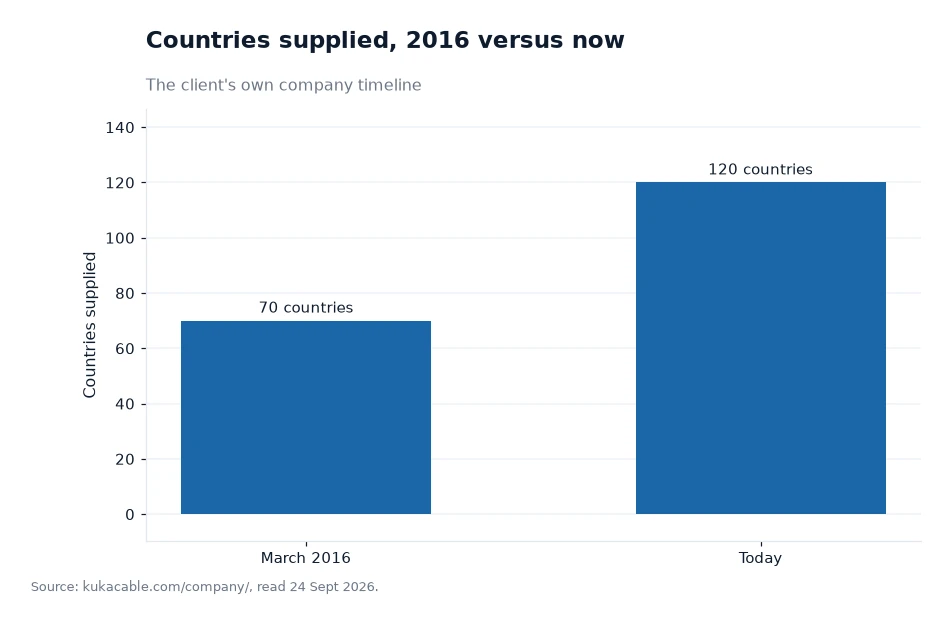
These bars answer a different question from the six documents, and they are shown here as the manufacturer's published figures on reach rather than as a cable property. They matter to a supplier assessment because a company that has sold into 120 markets has already produced the paperwork that importers in those markets require. The step from 70 to 120 countries is 50 markets added between March 2016 and the date the pages were read, which is about 4.8 a year if the pace were even; that rate is my own arithmetic and assumes something no business does.
Frequently asked questions
Which document should be requested first?
The certificate that covers the offered model, because it fixes the standard and the year that the rest of the documents must agree with. Once that is on file, the datasheet, the cross-section table and the test record can all be checked against it rather than read in isolation.
What should be asked for when a supplier sends only a price?
Ask for the six items in the table above, and ask for the commercial gaps in writing: price per metre, minimum order quantity, lead time, packing, shipping terms and warranty. The manufacturer's own pages leave those items unpublished, so they can only be settled on the quotation.
Building the file before the order
Request the documents before the price discussion and put a reference number on each. Check the model name on the certificate, the standards row on the datasheet, the strand build in the cross-section table and the elongation figure in the test record. Then ask for the commercial terms, including what the quoted price covers and what it excludes, and keep the answer with the technical file. A supplier that can supply all six on request is a supplier whose offer can be compared on facts rather than on adjectives.
Document names and counts in this checklist were taken from KUKA CABLE's own web pages; I transcribed them on 24 Sept 2026[1].