When an order is split across several Chinese suppliers, pickup coordination starts with a shared view of what is ready, where it is located, and what still has to happen before cargo can move. A pickup date should follow verified packing and document milestones, not substitute for them. Buyers can reduce missed handoffs by giving every supplier the same shipment reference, collection instructions, contact window, and exception process.
Key takeaways
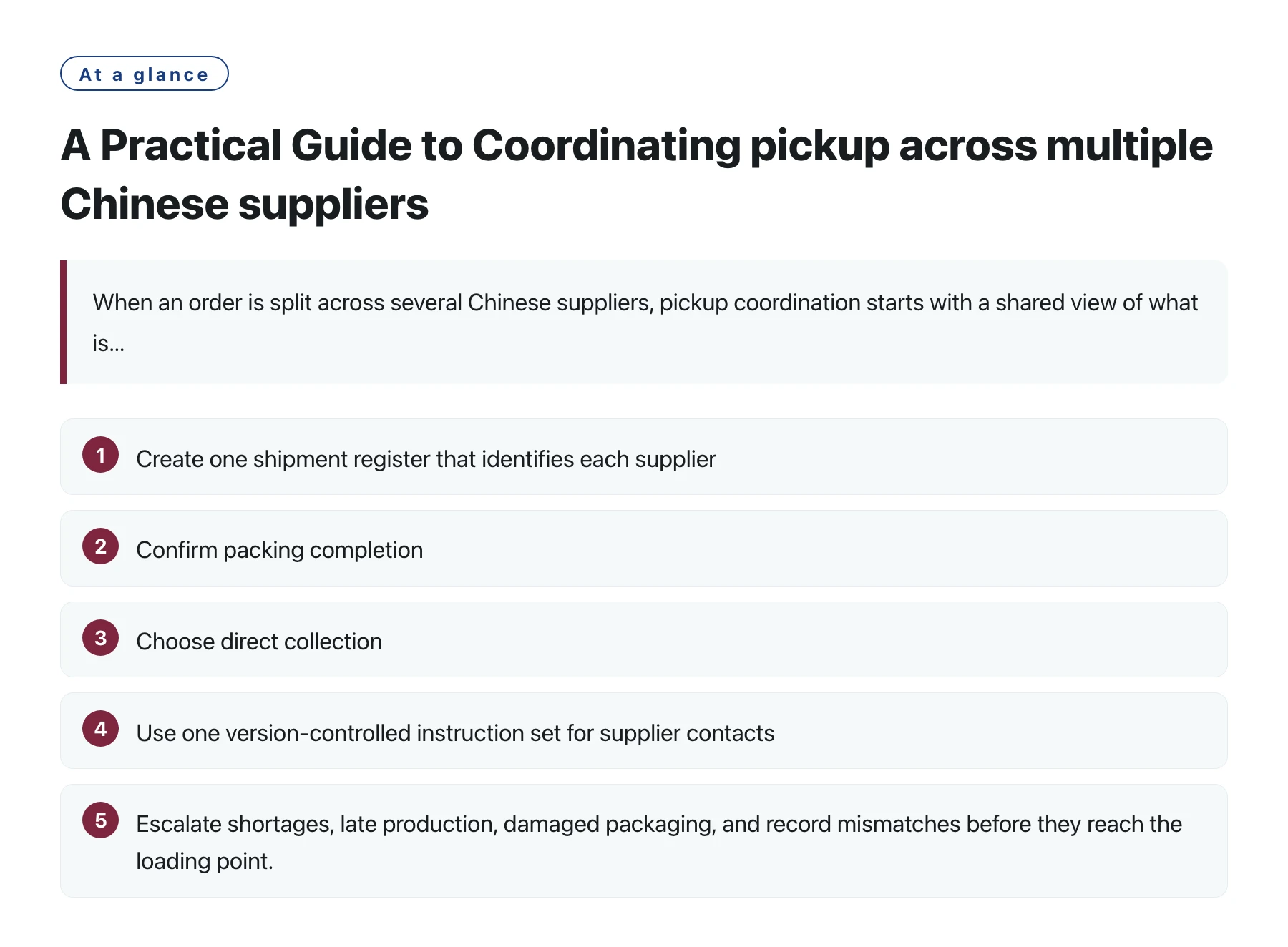
- Create one shipment register that identifies each supplier, cargo lot, location, readiness status, and owner.
- Confirm packing completion, inspection release, dimensions, weights, marks, and pickup access before dispatching a vehicle.
- Choose direct collection, staged consolidation, or separate shipments according to timing, compatibility, and risk.
- Use one version-controlled instruction set for supplier contacts, warehouse receipt, and document handoffs.
- Escalate shortages, late production, damaged packaging, and record mismatches before they reach the loading point.
- For U.S.-bound goods, keep importer-side entry information and supporting records aligned with the actual cargo.
Collecting goods from several suppliers is a coordination problem as much as a transport task. A supplier may finish production on one date, complete packing later, and be ready for collection only after inspection, labeling, or document corrections. If each party works from a different assumption, a truck can arrive before the cargo is released or one lot can miss a consolidation window. A common timeline and clear handoff records make the plan easier to adjust.
Build a shipment register before setting pickup dates
List every supplier and the purchase order or lot associated with the shipment. Capture the factory or warehouse address, local contact, phone or messaging channel, cargo description, package count, estimated gross weight and dimensions, target readiness date, and current status. Add who is responsible for confirming each field and the time at which the last update was received. Where multiple orders have similar product names, use distinct references that appear on packing lists and labels.
Separate production completion from cargo readiness. A useful status sequence might include production in progress, finished goods awaiting inspection, inspection released, packing complete, documents checked, pickup confirmed, and received at consolidation point. Define what evidence moves a lot from one status to the next. This prevents a verbal 'almost ready' from being interpreted as authorization to dispatch transport.
Set one person to maintain the master register and circulate a dated version after changes. Suppliers can confirm only the rows that concern their own cargo, while the logistics coordinator keeps the complete view.
Confirm that the pickup can be completed in one visit
Before booking transport, ask the supplier to confirm the cargo is packed, counted, marked, accessible, and released for collection. Request the latest packing list and verify that carton or pallet counts match the pickup instruction. Check whether the vehicle can reach the loading point, whether a booking or gate pass is needed, what loading equipment is available, and the hours when cargo can be released. If a facility has a specific vehicle or safety requirement, share it with the carrier before arrival.
Compare the updated package dimensions and weights with the planned vehicle and consolidation space. If figures are estimates, label them as estimates and decide who will confirm the final values. A substantial change can affect vehicle selection, warehouse allocation, freight quotation, or loading arrangement, so it is better to surface the change before collection than at the loading bay.
Use a pickup confirmation with the supplier contact, carrier contact, date and time window, vehicle identifier when available, cargo reference, expected packages, and the receiving destination. Ask the driver or warehouse to record any difference between the instruction and the goods actually handed over.
Choose how the separate lots will move together
Direct collection to a consolidator can simplify the onward handoff when suppliers are geographically manageable and the receiving point can accept staggered arrivals. A staged plan may make sense when one supplier finishes well before the others, provided storage, handling, and release costs are understood. Separate shipments may be preferable when cargo has incompatible handling needs, a tight delivery deadline, or a risk that one late lot would hold all the goods.
Compare options using the full sequence of handling and timing, not only the pickup charge. Consider the distance between collection points, expected waiting, consolidation cutoff, receiving capacity, cargo compatibility, repacking needs, and how a late or short shipment changes the plan. Ask the logistics provider to state what the quote includes and which events can add charges, such as waiting time, extra handling, storage, or a second collection.
Avoid combining goods solely because they share a destination. Fragile products, moisture-sensitive items, hazardous goods, oversized packages, or products requiring particular temperature or handling conditions may need separate arrangements. Confirm classification and handling requirements with a qualified transport provider using the actual product and packaging information.
Keep the cargo and paperwork aligned at each handoff
Assign a shipment reference that follows each lot from supplier release to the receiving warehouse and onward booking. Ensure the commercial invoice, packing list, cargo labels, and shipment register use compatible descriptions and quantities. When suppliers issue documents separately, preserve the supplier and purchase-order link rather than merging records so aggressively that the origin of a package becomes unclear.
Set a document review point before pickup or before the cargo reaches the consolidation deadline. Check that descriptions are understandable, package counts agree, and any required product or customs documents have an identified owner. For goods imported into the United States, U.S. Customs and Border Protection's importer guidance explains that importers should understand entry requirements and maintain records for their transactions.[1] Importers shipping to other destinations should confirm local requirements with the relevant customs authority or a qualified broker.
At receipt, have the warehouse record the arrival date, package count, visible damage, labels, and any discrepancy against the packing list. Photograph exceptions with the shipment reference visible where practical, and notify the supplier and buyer promptly. A receipt record is not a substitute for a product inspection, but it preserves evidence about the condition and quantity observed at handoff.
Prepare an exception plan for late or incomplete cargo
Multi-supplier schedules change. A lot may be held for rework, an inspection may identify a problem, a packing list may need correction, or a carrier may miss an appointment. Decide in advance who can authorize a partial pickup, whether goods may be stored, what cutoff triggers a revised sailing or booking, and how extra charges are approved. Keep a backup contact for each supplier and the receiving location.
When one lot is late, compare the cost and consequence of waiting with the cost and consequence of sending available cargo separately. Document which orders move, which remain, how the paperwork changes, and who must be notified. Do not let a schedule decision obscure an unresolved quality hold: cargo that has not been released under the agreed inspection or acceptance process should remain clearly marked as on hold.
A daily readiness update can be useful near the pickup window, but it should focus on changes and blockers instead of duplicating the entire register. Ask suppliers to report a variance as soon as it becomes likely, with the affected quantity, new expected date, cause, and next update time.
Make the handoff instructions easy to execute
Send each supplier only the instructions needed for its part, while keeping a master version for the buyer and coordinator. Include the shipment reference, pickup window, carrier or warehouse contact, labels to apply, documents to prepare, and the person to contact if the cargo differs from the plan. Use clear file names and revision dates; withdraw outdated pickup instructions after a change so a factory does not print an old version.
For teams coordinating overseas suppliers, warehouse receipt, and shipping documentation, review JS Sourcing support against the actual handoffs required. Keep the buyer's approval of product release, shipment split, and document contents with named decision-makers, and record any delegated logistics authority in writing.
Sources
Frequently asked questions
Should all suppliers deliver to one consolidation warehouse?
Not always. Compare route, timing, handling requirements, storage, extra handling, and the effect of late cargo. Separate shipments may be clearer when lots have incompatible requirements or different deadlines.
When should a buyer schedule a pickup?
After confirming the goods are released, packed, counted, accessible, and supported by the needed documents. Confirm the pickup window and receiving capacity with the carrier and destination.
What should be recorded when cargo reaches a warehouse?
Record the shipment reference, arrival time, package count, visible damage, label or document mismatch, and any agreed exception. Notify the responsible parties while the handoff details are current.
Can separate supplier invoices be merged into one document?
Document requirements depend on the transaction and destination. Preserve the link between each supplier, purchase order, cargo lot, and supporting document, and ask a qualified customs broker or authority how the entry should be filed.